
Bridging Climate Change and City Assessment Communities
On February 12th, a group of researchers, designers, scientists, and practitioners joined members of the Urban Climate Change Research Network’s Secretariat for a virtual discussion highlighting key research findings, policy-relevant insights, and city case studies from the Third Assessment Report on Climate Change and Cities (ARC3.3).
On February 12th, a group of researchers, designers, scientists, and practitioners joined members of the Urban Climate Change Research Network’s Secretariat for a virtual discussion highlighting key research findings, policy-relevant insights, and city case studies from the Third Assessment Report on Climate Change and Cities (ARC3.3).
Central to the session was a collaborative conversation among UCCRN Co-Chairs, Lead Authors, and fellow researchers, practitioners, and designers on how ARC3.3 Elements can be interpreted and applied moving forward. Key takeaways from this aspect of the session can be found below.
Lessons and Main Points from the Conversation
- ARC3.3 and other major climate assessment processes should be regarded as complementary, not duplicative. Unlike other assessments that operate under stricter methodological and authorship guidelines. ARC3.3 maintains greater flexibility to incorporate diverse case studies, emerging research, and locally grounded insights; while maintaining scholarship at the highest level. Ongoing collaboration and information-sharing between networks and researchers will be essential to continue strengthening urban climate action.
- Coordinating Lead Author of the recently-published Finance Element, Paolo Bertoldi, stressed that sufficient global capital exists to meet climate financing needs, yet much of it continues to flow toward mitigation in wealthier regions. The urgent gap remains financing adaptation in cities across the Global South. Bertoldi underscored the role of public financial management in reducing project risk and highlighted insurance companies as potential partners in supporting resilience and sustainable development.
- Daniel Bader, Coordinating Lead Author of the Urban Climate Science Element, describes this underway Element as UCCRN’s most comprehensive exploration of the urban climate system to date. In addition to temperature and precipitation projections for 250 cities and sea level rise projections for 100 cities, this Element includes wet bulb temperature projections for the first time, capturing combined impacts of heat and humidity. These data reinforce the need for city-specific monitoring systems and locally grounded adaptation responses.
- Jeffrey Raven and Mattia Federico Leone, Coordinating Lead Authors of the Planning, Action, and Urban Design Element, urged participants to collaborate with UCCRN in applying and testing the Element’s frameworks in cities across the world. According to Mattia, the best way to use this Element is through practical application to gain global feedback from local perspectives.
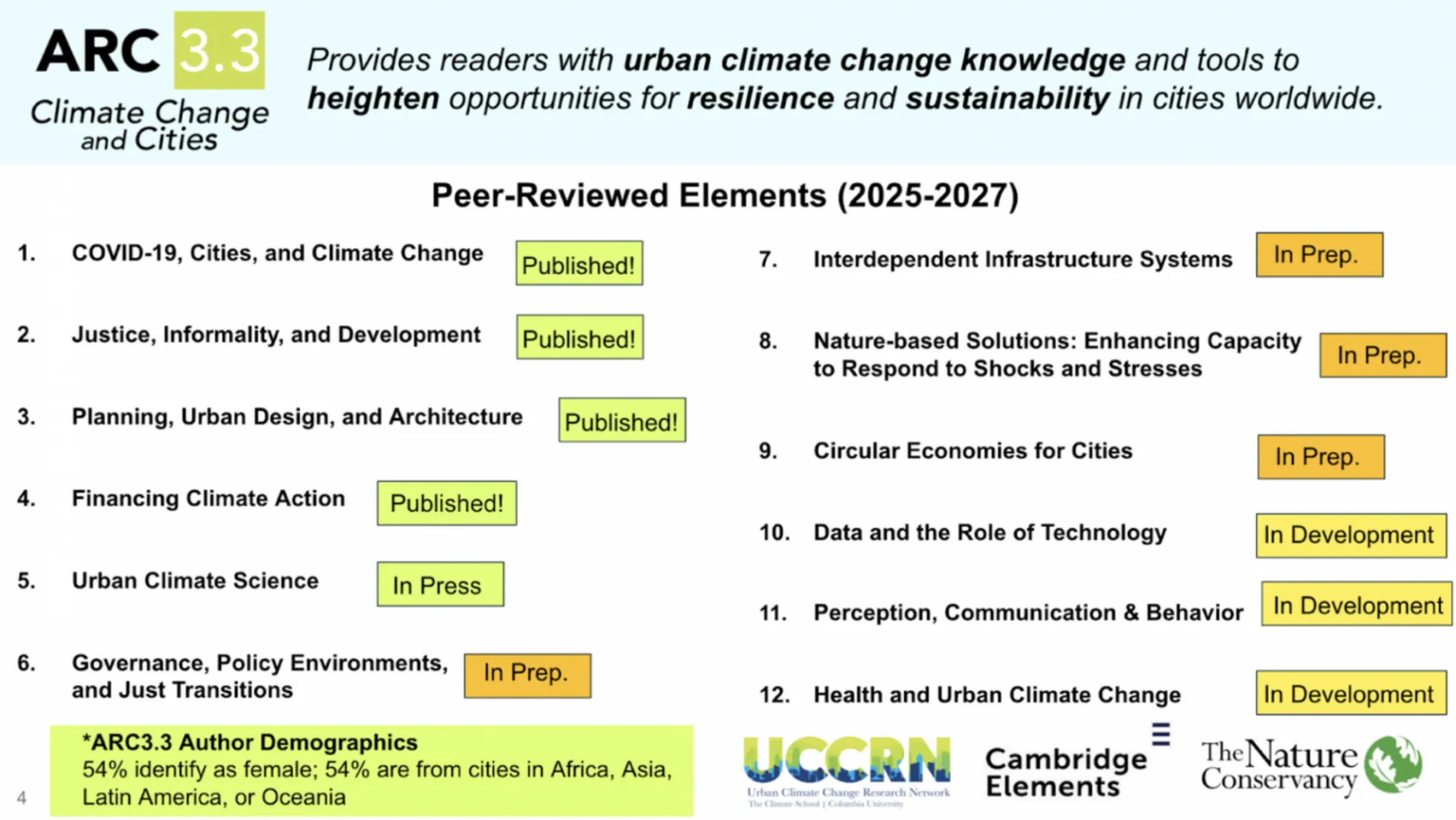
With global temperatures rising and political momentum fluctuating, 2026 remains a critical year for assessing and understanding climate change. Through intermittent publications of ARC3.3 by Cambridge University Press, UCCRN is releasing a series of twelve thematic Elements that synthesize recent research, identify key knowledge gaps, and provide policy-relevant insights to accelerate and scale urban climate action. The first four Elements are available online through open access, and the next four will be submitted by April 1st, 2026.
Positioned in the middle of the publication process, this discussion shared major findings and key messages from ARC3.3 to highlight how each Element can inform ongoing and future urban climate assessment work.
What Makes ARC3.3 Unique?
- Greater flexibility allows for expanded authorship with strong representation from the Global South
- The modular publication style of 12 total Elements released incrementally ensures cutting edge research, policy insights, and practice
- Greater flexibility allows UCCRN authors to incorporate emerging science with real world examples
- The first two iterations of the ARC3 series allows for reliable benchmarking and continuous evaluation
- ARC3.3 greatly benefits from UCCRN’s City Solutions Case Study Atlas (City CSA). More on this below
- The diversity of case studies has allowed UCCRN to become a hub for a wide range of languages, specifically through the City CSA
As mentioned during the session by Gian Carlo Delgado – UCCRN’s Mexico City Hub Director and Economist at the National Autonomous University of Mexico – the Urban Climate Change Research Network has been developing case studies for the past 15 years. Since reflecting on the First Assessment Report on Climate Change and Cities (ARC3), UCCRN has been developing the case study docking station for the past year and is excited for the City CSA to become publicly available in the next month.
The City Case Study Atlas is a curated, metadata-driven repository of urban mitigation and adaptation case studies. Relying on a diversity of case studies and locally grounded innovations, this living database integrates climate projections with policy and design interventions, enabling researchers, practitioners, and policymakers to identify and utilize climate mitigation and adaptation solutions case studies from cities around the world. Additionally, the City CSA visualizes city-level data – including climate projections and geospatial information – to support comparative analysis, inform decision-making, and strengthen the translation of climate science into actionable urban strategies.
What Comes Next?
Currently, the first four Elements of ARC3.3 are publicly available online: Learning from COVID-19; Justice for Resilient Development; Planning, Urban Design, and Architecture; and Financing for Urban Transitions. By April 1st, 2026, the next four Elements will be released for open access: Urban Climate Science; Governance, Policy Environments, and Just Transitions; Interdependent Infrastructure Systems; and Nature-based Solutions.
In addition, the City Solutions Case Study Atlas will be launched in the coming month. UCCRN remains open to new case study submissions, cross regional collaborations, and the testing of planning and design frameworks in local contexts.