
Small Towns, Big Lessons: The Nordic Node’s Approach to Urban Climate Adaptation
Many global climate initiatives focus on big metropolitan areas, regarding both impacted areas and sources of solutions. However, as discussed in a conversation with Dr. Martin Lehmann, Co-Director of the Urban Climate Change Research Network’s Nordic Node, some of the most innovative climate adaptation solutions are emerging in small coastal towns and municipalities.
Many global climate initiatives focus on big metropolitan areas, regarding both impacted areas and sources of solutions. However, as discussed in a conversation with Dr. Martin Lehmann, Co-Director of the Urban Climate Change Research Network’s Nordic Node, some of the most innovative climate adaptation solutions are emerging in small coastal towns and municipalities.
The Nordic Node formed (as KlimaLab) in 2010 after the “failed COP here in Denmark,” when Jeffrey Sachs and the Danish General Consulate in New York reached out to Danish Universities to spur momentum through climate action. Starting as a collaboration between Aalborg University and Columbia University, Dr. Lehmann gradually transitioned to a more focused partnership with UCCRN through student exchanges and research projects.
This Regional Hub brings unique value to UCCRN by tapping into “The Nordic Way,” which involves a close collaboration between cities and regions, academic institutions, industry and business, and civil society. The Nordic countries – Norway, Sweden, Denmark, Finland, and Iceland – have some of the most ambitious climate and energy policy agendas in the world. Using the experiences and results from these agendas, the Nordic Node aims to ensure that they are properly analyzed and dispersed, underpinning the UCCRN response agenda supported by knowledge and rigorous research.
In general, the Nordic Node emphasizes local, practice-based climate adaptation. One of the main ways the Regional Hub has supported this initiative is through the Case Study Atlas, which is in the process of publishing a global repository of urban climate adaptation case studies. This allows researchers and practitioners to contribute real-world examples of climate adaptation in action from across the world.
The central challenge addressed through Dr. Lehmann’s work and the Case Study Atlas is how to compare climate adaptation practices across different regions. For this reason, Dr. Lehmann recognizes the importance of case study cataloguing and taxonomy, a process through which climate scientists can categorize urban case studies and “make sense of all that is coming out of action on the ground.” This enables the Nordic Node to avoid imposing a European or Global North perspective on other regions, instead allowing the taxonomy to emerge from the cases themselves and enables a co-creation process with collaborators worldwide.
Summarized during the interview, Dr. Lehmann remarked that there is a “sense of urgency in getting something produced, but there is also a need for a sense of rigorousness so that we produce something that is actually useful, not just for countries in the Global North, like in Europe, for example, where there might be a fairly similar understanding.” Warning against sacrificing rigor for the sake of urgency, Dr. Lehmann concludes that “if we organize this in a way that really is [just] from a Global North perspective, then that is just, in a way, new colonialism.” Therefore, Dr. Lehmann works to “distill potential taxonomies from what actually comes from practice rather than push a certain taxonomy on people,” making this both a reflective and iterative process.
In addition to balancing rigor and urgency through the cataloguing and taxonomy of case studies, Dr. Lehmann directs his research toward small towns and municipalities, challenging the traditional emphasis on large global cities as the only centers of innovation. In countries such as Denmark, for example, most municipalities facing climate impacts are small towns, experiencing issues including coastal flooding, sea level rise, and storm exposure. Through the Nordic Node, researchers are examining local climate action plans to understand what adaptation measures are underway and how these measures differ between municipalities.
Many adaptation measures in this region are connected to the work of the Klimatorium: Denmark’s Internationale Klimacenter. Located in a small municipality in western Denmark, the Klimatorium “build[s] bridges between research and practice to ensure that ideas and visions become concrete climate solutions.” Starting as an idea in 2015, the Klimatorium gradually attracted larger sums of local, national, and EU funding. As of this month, the Nordic Node is happy to announce the Klimatorium as its headquarters.
According to Dr. Lehmann, the location of the Klimatorium in the periphery of Denmark is “interesting and very inspiring.” Explained during our conversation, “[w]e have solutions here in this place. We have solutions on the edges, on the fringes of Denmark, not because of support from the central government, but despite that, and because we can.” And they have.
In 2024, the Klimatorium was appointed as a national climate hub for the EU and is in the process of expanding in the Netherlands and New Zealand. Through local, national, and international funds, the Klimatorium has rapidly transitioned into an institution of international recognition, while staying “true to [their] roots of being local, and of being a value locally.”
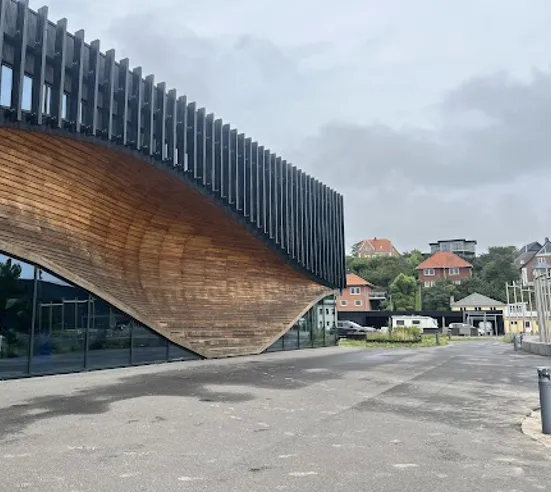
Future priorities for UCCRNs’ Nordic Node include expanding collaboration across Nordic countries, strengthening international partnerships, and continuing to develop the Case Study Atlas through global contributions. Ultimately, Dr. Lehmann believes that the Nordic Node is contributing to a collaborative global knowledge platform where cities across the world can share lessons and learn from each other to address climate change.
Dr. Martin Lehmann is an Associate Professor in the Department of Sustainability and Planning at Aalborg University in Denmark. Dr. Lehmann and Ms. Sarah Lund – Director of International Collaboration and Strategic Sustainability Initiatives at the Klimatorium work together as Co-Directors of the UCCRN Nordic Node, along with Professor Nicola Tollin: UNESCO Chair on Urban Resilience, Department of Technology and Innovation, at the University of Southern Denmark.
The Urban Climate Change Research Network (UCCRN) is a global consortium of over 2,000 scientists, scholars, and practitioners from over 150 cities dedicated to assessing climate change risks, adaptation, and mitigation from an urban perspective. To strengthen ongoing collaborations and knowledge exchange for and within cities, UCCRN has expanded to include fifteen Regional Hubs, each filled with field directors, program coordinators, and researchers.